Untitled Document

All Campus Kitchen News


Choosing to Serve


By | May 15th, 2012 | Categories: Beyond the Kitchen, CKPguests, National News


I have been around service my entire life. My parents were both extremely politically active and the importance of taking care of people was ingrained in me from a very young age. My mother sat on the first Advisory Board of the Women’s and Children’s Free Restaurant – a meal and service provider here in Spokane, WA. She used to make me volunteer at the dinners every week, and I begrudgingly went all through high school. I would like to say that I went happily to set up the chairs and serve the dinners, but I really didn’t want to be there – there were usually other things I would have rather been doing. And that’s where my true relationship with service began.

It was the fall semester of my junior year of high school. I found myself in Mr. Long’s 4th period Leadership class – a class where students came up with service projects and saw them through to fruition. To be honest, I took the class because I thought it would be easy and would look good on my college applications. I skated through the first month, putting in minimal effort and showing even less interest in any of the service projects. One day, while watching the minutes click by till lunch, I was snapped back to reality by Mr. Long asking me to stay after class. He informed me that he knew I wasn’t really doing anything in his class, and gave me two choices: I could continue to perform at a lackluster level and get by, or I could make it an amazing experience. I chose the latter.

That year I spearheaded the largest food and clothing driving North Central High School had ever seen. NC is located in one of the poorest neighborhoods in the state, so the need is always high. I continued with the Leadership program at North Central and was one of the first students to receive a letter in Leadership. I actually lettered in something! Me, the girl who didn’t join anything and wasn’t coordinated enough to make a sports team!

I continued doing service projects on my own sporadically while I worked my way through Gonzaga in the restaurant industry. One time, I convinced all of the servers and bartenders downtown to donate their tips from one night of work to the Red Cross to benefit Kosovo refugees. Another time, I made Mardi Gras masks and sold them to raise money after Hurricane Katrina. Service has always been there for me. I can’t say that service would be as important to me as it is if that one teacher hadn’t called me out. That is why it means so much to me to do the same thing for students, not only at the Campus Kitchen at Gonzaga University, but at our Campus Kitchens across the country. That said, thank you Mr. Long. You truly made a difference, not only in my life, but in the lives of many.


Emily Paulson is a Program Manager at The Campus Kitchens Project and the Coordinator for the Campus Kitchen at Gonzaga University.


Congratulations Class of 2012


By | May 14th, 2012 | Categories: Beyond the Kitchen, National News


The Campus Kitchens Project is proud to recognize the following students for their hard work. Congratulations to the Class of 2012!

Devon Baniak Saint Louis University
Molly Bulman William and Mary
Bridget Greene University of Detroit Mercy
Mary Gourley East Carolina University
Amy Heard Baylor University
Andrea Kleger Saint Louis University
Hannah Laird Baylor University
Ryne Macht Saint Louis University
Ashley McCullough East Carolina University
Ashley Minton University of Maryland Eastern Shore
Stephanie Mutchler William and Mary
Lana Nasrallah East Carolina University
Cassie Powell William and Mary
Sarah Schach East Carolina University
Alex Shabo Washington and Lee University
April Sharp East Carolina University
Kelsey Sizer Washington and Lee University
Eryn Vincent Auburn University
Shiri Yadlin Washington and Lee University
Ashlyn Yuratich Auburn University
Lu Zhou Saint Louis University
Lauren Ziegler Saint Louis University
Amanda Zurad William and Mary


Food Stamps Program Empowers Families, Revitalizes Economy


By | May 9th, 2012 | Categories: Beyond the Kitchen, CKPguests, National News


I’ve had the same best friend since I was 10 years old – that’s 15 years of memories and loyalty through good times and bad. She’s one of the smartest people I know, so it was no surprise when she was accepted to the University of North Carolina at Chapel Hill – one of the top five schools in the U.S. What nobody expected was the recession that hit hard during our college years. By the time we graduated from our respective schools in 2009, the economy was in the gutter and employment prospects for recent graduates were depressing, to say the least.

Armed with a double degree from UNC and an excellent résumé, Rose moved to southern New Jersey to be closer to her family and pursue her career in Philadelphia. Applying for jobs became a full time job in itself; day in and day out, she sent her résumé to dozens of employers. Rose spent a full year looking for work, during which time she was able to find a seasonal, part-time, minimum wage job in a department store, and nothing else.

In 2009 I graduated from one of the most prestigious universities in the country eager to begin my career. But as the months passed and I watched my savings dwindle, I became desperate. With zero income and mounting expenses, I was forced to find different ways to make ends meet. One thing that was a tremendous help during that difficult time was applying for food stamps. My partner and I received over $300 a month in food stamps which lifted an enormous burden from our budget each month. No longer did I feel guilty for buying food. It also encouraged us to make healthier food choices because we had incentive to stay home and cook. We could stretch our stamps even farther when we shopped at the local produce shops, which surprisingly also accepted EBT. – Rose D.

Rose’s story is valuable for several reasons. For one, it defies stereotypes; a young, educated white woman may not be the first image to come to mind when people talk about food stamps participants. Food insecurity can affect anyone. Her story illuminates the reality that we are facing as a nation: the economic downturn has widened the wealth gap and has driven millions of people to the edge of poverty, which is why record numbers now rely on SNAP (Supplemental Nutrition Assistance Program, the new name for food stamps since 2008). Every $5 of food stamps benefits spent generates $9 in economic activity; when Rose used food stamps at her local produce stand, she stimulated the local economy. Perhaps most important, her story exemplifies the life raft that SNAP can be for people struggling through hard times. The average participant uses food stamps for about 9 months, often just long enough to help them through a difficult transition, such as unemployment, and avoid falling into poverty. Rose relied on SNAP for a few months to put food on the table and divert her money to other living expenses until she got back on her feet. Without that support, her situation might easily have gotten much worse before it got better.

Food stamps have a long history of responding to the needs of American citizens. The original Food Stamps Program, an experiment that lasted from 1939-1943, arose in response to widespread unemployment and agricultural surplus – when those conditions changed, the program was terminated and followed by 18 years of studies and reports. President Kennedy launched the Pilot Food Stamp Program in 1961, and in 1964 the Food Stamps Act was signed into law, reaching nationwide availability by 1974. In the past four decades, the Food Stamps Program has undergone countless reforms and has faced a wide spectrum of public opinions. This past December, SNAP reached record levels of enrollment, with 46.5 million Americans taking part in the program. Still, 3 in 10 eligible people are left without access. Enrollment levels reflect the state of the economy, and the food stamps program expands and contracts in reaction to the changing level of need.

One reason that food stamps can be so controversial is their perceived expense to taxpayers. It’s important to understand the facts about where the money comes from and where it goes. First of all, SNAP is 100% federally funded. Additionally, the federal government pays for half of all costs that states incur in administering the program, which amount to less than 5% of the total expenditure. Furthermore, SNAP accounts for only one penny out of every dollar in the federal budget – truly a small price to pay to prevent hunger, lift families out of poverty, and generate economic activity. When you consider the fact that the consequences of hunger cost the U.S. $167.5 billion per year, it makes sense that the benefits outweigh the costs. We cannot afford, financially nor morally, to let our neighbors go hungry.

Regardless of one’s stance on taxes for social welfare initiatives, much of the controversy and disdain for food stamps arises from misinformation. A plethora of myths complicate the public perception of SNAP:

  • Myth: People use food stamps to avoid having to work.
    Reality: 30% of households receiving SNAP have at least one employed family member. Further, 76% of those households include children, elderly, or disabled family members. Although temporarily suspended due to the economic crisis, there is also a 3 month limit  (in a 3 year period) for unemployed people to receive SNAP, incentivizing employment and job training.
  • Myth: Lots of people are scamming the system and fraud is prevalent.
    Reality: The SNAP fraud rate is less than 1%. In addition, when underpayment or overpayment errors occur (in less than 5% of cases) it is usually due to caseworker error.
  • Myth: Illegal immigrants are using taxpayer-funded food stamps.
    Reality: Illegal immigrants are not, and have never been, eligible for food stamps. Legal immigrants must wait at least 5 years to apply, and make up a very small portion (less than 4%) of participants.
  • Myth: Having SNAP leads to poor dietary choices and higher rates of obesity.
    Reality:Studies show no link between food stamps and overeating, or between food stamps and weight gain.

These are only a few examples of the myths, in addition to stigma and public opinion battles, that complicate the issue. The simple bottom line is this: one in six people is struggling with hunger in the wealthiest nation on Earth. SNAP is the first line of defense against hunger, especially for children, disabled people, and the elderly. It lifts people out of poverty, and helps them avoid more severe and long term poverty. It generates economic activity, especially in local economies. None of these facts can be ignored, especially in times like ours. We have both economic incentive and moral imperative to sustain and support the Supplemental Nutrition Assistance Program.

SNAP is an issue close to my heart and deeply rooted in my passion for food justice. My best friend relied on food stamps during one of the most difficult periods of her life. My previous work as a case manager involved helping my clients access nutrition and other public benefits. And now at the Campus Kitchen at UMass Boston I am working to develop a SNAP outreach initiative to bring more holistic and sustainable food security to the families we serve. Because 3 in 10 people living at risk of food insecurity are not getting food stamps, I want to help dispel the myths, fight the stigma, and educate people about their eligibility. Because the application process can be daunting and confusing, I want to help them get started. In this way, CKUMB can have an even greater and longer-term impact on hunger in Boston.

How can you help?

  • Volunteer with CKUMB or the Campus Kitchen closest to you. Find your local food bank or other agency serving low-income communities and ask if they have outreach programs. If there’s nothing in your area, start something!
  • Donate to support our outreach efforts.
  • Educate yourself and others about food stamps facts and eligibility. Help a neighbor in need with the application process.

How can you get help?

  • Call your state hotline number to ask questions.
  • Read about eligibility and how to apply.
  • Apply; even if you’re not 100% sure you’re eligible, it’s worth a shot if you’re in need.
  • Call the National Hunger Hotline at 1-866-3hungry or 1-877-8hambre to find emergency assistance today.


Container gardening for the urban farmer


By | May 8th, 2012 | Categories: Beyond the Kitchen


The DC Truck Farm

There’s nothing quite like the sweet taste of fresh, homegrown veggies straight from the garden. But what happens if you’re an urban gardener lacking enough space for a vegetable garden? Ever consider growing them in containers?

Did you know that nearly any type of vegetable, and many fruits, can be successfully grown in pots? From lettuce, tomatoes, and peppers to beans, potatoes, and even vine crops like squash and cucumbers thrive in containers. You can grow plants in virtually anything that holds some soil and has holes in the bottom for drainage. It’s only bounded by your imagination – a chance for some really creative recycling.

Suitable drainage is always important for the successful growth and health of all plants. So as long as you provide drainage holes, just about anything under the sun can be used for growing vegetables, from large coffee cans and wooden boxes to five-gallon buckets and old washtubs, even in the bed of a pick-up truck.

Potted vegetables can produce an adequate supply of food for urban gardeners without the need for large garden plots. Potted veggies also eliminate the need for continual maintenance as well and keep unwanted critters away. So if you’re an urban gardener looking for fresh, mouth-watering vegetables straight from the garden, why not consider some of these alternative container gardening methods? It is easy, economical, versatile, and fun! Having your own container vegetable garden not only provides you with the instant gratification of having healthy food, but can even save you money in the long run!

For more information on how to create your own container gardens check out these helpful resources! And these!


The many roles of community gardens


By | May 7th, 2012 | Categories: Beyond the Kitchen


CKUMB's garden plots

When I was growing up in New Hampshire, I had access to not one but three gardens. I helped grow flowers, strawberries, pumpkins and wax beans in the yards of my mother, grandfather, and grandmother. I hated weeding the rows and rows of soil, but the fresh produce at the end made it all worth it. There’s nothing quite like a freshly picked strawberry.

I may have itched to leave suburbia, but now that I’ve resettled in metro DC, I find myself missing those gardens. Free space isn’t readily available in an urban environment, and farming or gardening in a city requires a little more creativity. That’s where community gardens often come in. And they can have a bigger impact than you might think.

The first community gardens popped up in Detroit in the 1890s, and proved essential during the first half of the twentieth century. During both WWI and WWII, the US government encouraged citizens to create community gardens, later known as ‘Victory Gardens,’ to “supplement and expand the domestic food supply.” In between those two wars, community gardens helped the unemployed masses survive the Great Depression.

There was a lull in popularity after the end of WWII, but community gardens made a resurgence in the 1970s. Abandoned city plots were re-purposed as gardens, which not only provided food, but also brought neighborhoods together, created spaces for educational programs, and emphasized the importance of sustainability and urban development. Today, our Campus Kitchen at University of Boston uses community garden plots to teach children about healthy eating and gardening.

Another nonprofit, ampleharvest.org, taps into community gardening and helps gardeners feed their neighbors. By providing a resource where gardeners and food pantries can connect to “enable gardeners to donate their excess harvest to the needy in their community instead of allowing it to rot in the garden,” ampleharvest.org puts community gardens to work, reduces waste, and fights food insecurity.

Community gardens have filled nutritional gaps for many people over the decades, whether during a depression, a war, or just a rough period. They can simply be a patch of land for someone to pursue a hobby, or they can be an outdoor classroom where children can learn about healthy eating habits. They can feed a family, or with the right resources, feed a community.


For more information about the history of community gardens in America, click here.


What will happen to them?


By | May 4th, 2012 | Categories: Beyond the Kitchen, Local News


Right now, I am sitting in my living room watching a documentary on the final days of Dr. Rev. Martin Luther King, Jr.’s life, supporting the plight of sanitation workers on strike in Memphis.  In the last speech of his life, he rephrased the story of the Good Samaritan stating, “The question is not, ‘If I stop to help this man in need, what will happen to me?’ ‘If I do not stop to help the sanitation workers, what will happen to them?’ That’s the question.”

This afternoon, on my way to drop off meals for a self-advocacy meeting for adults with disabilities, I saw an awesome moment on the street.  It has been a stormy day, and just as I was heading out to Life Navigators, the rain began again.  As I pulled up to a red light, a small elderly woman on the corner lost hold of her umbrella in a gust of wind; she watched sadly as it tumbled into the street. A car came through the intersection; its driver saw the umbrella and the woman on the corner and noticing that no one was coming behind it, he stopped the car.  A young man jumped out into the rain, grabbed the umbrella, which had made its way across two lanes of traffic and returned it to the now smiling woman on the corner.

To rephrase Dr. King, if he stops to help this woman in need, what will happen to him?  He got wet in the rain, a moment of discomfort before returning to his car.  What would have happened to her if he had not stopped?  How long would she have had to walk in the rain?  Thankfully we don’t have to wonder because of a kind young man.

It makes me step back to think about the ‘sanitation workers’ that are in my life and in the lives of our student volunteers.  They are the homeless and at-risk homeless members of Repairers of the Breach, making important advances in their lives such as obtaining birth certificates and identification, seeking medical care at the clinic staffed by student nurses and physician’s assistants and getting counseling for substance abuse.  They are the children of HeartLove Place who attend Kids’ Café twice a week, getting a meal before they go home for the evening.  They are the families at Children’s Hospital who are supporting their children battling cancer.

If we do not stop to help, what will happen to them?  A mother at Children’s once told us it was the first real meal she had eaten all week; she would have had another ‘meal’ from the vending machine had CKMU not been there.  The same can be said of many of our other guests.

As we end the school year, CKMU wants to thank our amazing LT and all of our awesome student volunteers.  Thank you for sharing your time and culinary skills with the community, providing over 16,500 meals this school year.  Good luck on your finals next week and have a great summer!  Hope you summer includes some time in the kitchen!


CKSLU Summer Opportunity


By | May 3rd, 2012 | Categories: National News


Still working on your summer plans? Consider an Americorps Summer Associate position at the Campus Kitchen at Saint Louis University. Beginning June 11th, you will spend the 8-week period fighting hunger in the Saint Louis community. Duties will include educating clients on healthy eating, leading volunteers in the preparation and delivery of meals, and supporting the work of gardens and farmer’s markets.

If you are interested, please contact ckslu@campuskitchens.org by May 10th.

Benefits include: Biweekly living stipend of $427 for the 8-week period, end of service educational or cash award.


UDC conference focuses on sustainable food practices, urban agriculture


By | May 3rd, 2012 | Categories: Beyond the Kitchen


Last Friday, the University of District of Columbia (UDC) held its second annual International Urban Sustainability Action Summit, which was sponsored by the College of Agriculture, Urban Sustainability and Environmental Science (or CAUSES for short). With a belief in “fair and equal access to healthy food options in the urban environment,” CAUSES focused this year on sustainable reclamation of both food and water. Since our Campus Kitchens work to reclaim food to provide healthy meals for their communities, the summit was obviously on our calendar of things to attend. It didn’t hurt that our CEO, Mike Curtin, was on a panel, either.

Friday’s keynote speaker was Will Allen from Growing Power, a nonprofit organization in Milwaukee, WI. Allen started Growing Power in 1995 after he started farming on the last tract of land zoned for agriculture within Milwaukee’s city limits. Allen realized that he “could grow food on-site in a neighborhood where there was little fresh food to be found,” and that tract of land turned into a space where children could learn about agriculture and where Allen could cultivate healthy food to give to his neighbors.

Allen is not only fighting food insecurity and unhealthy diets by providing access to healthy produce, but his work with urban youth helps teach the next generation about the importance of sustainability, agriculture, and healthy diets. Because of Allen, these children now know that there’s nothing quite like a fresh vegetable.

Many of our Campus Kitchens have also broken ground and created urban gardens. In October 2010, the Campus Kitchen at Gonzaga University in Spokane, WA created their garden, and they yielded their first crop in 2011. The lettuce, tomatoes, squash, garlic, and carrots from their garden were used to feed their clients; so much lettuce was grown, that CKGU was able to use it in every meal that summer. Our Campus Kitchen at Marquette University, in Milwaukee, also recently broke ground on an urban garden.

Urban gardens may require some creativity, and space may be limited, but the benefits of introducing a little farm to the city can create dietary and educational opportunities.


CKUMB Summer Internship


By | May 2nd, 2012 | Categories: National News


The Campus Kitchen at UMass Boston seeks a summer intern to be a part of our Leadership Team. The Campus Kitchen repurposes food donated by dining services and local ‘food rescue’ agencies to create healthy meals for local children and youth in need. We have a strong focus on serving the Dorchester neighborhood. In addition to our meal program, we are developing community gardening and nutrition education efforts, which will be a primary function of this position. During the summer, we will be serving up to five client agencies, with as many as 550 underprivileged youth.

Our weekly work is broken down into Food Resourcing, Cooking, and Delivery shifts conducted by volunteers and sometimes supervised by the Coordinator.

The responsibilities of a summer intern include, but are not limited to:

  • Leading volunteers in shift operations.
  • Administrative projects such as fundraising, marketing, etc.
  • Community outreach efforts (ex: helping clients access SNAP – food stamp – benefits; building partnerships with other local food justice initiatives).
  • Developing and leading programming initiatives, such as tending garden plots, working with community partners, teaching gardening skills to youth, building a nutrition education component, or building a partnership with another educational agency.

Qualifications:

  • Must be committed to the mission of The Campus Kitchens Project and to the fight against hunger.
  • Prior experience or skills in gardening, nutrition education or working with children is preferred but not requisite.
  • Knowledge in the areas of urban agriculture, health and nutrition, large-scale cooking, environmental science, or local food systems is a plus.
  • Applicants should be reliable and flexible.
  • Excellent communication and leadership skills
  • Able to take initiative and work independently
Dates: June 4 – August 3, 2012
Hours: 12/week, Monday through Thursday. Exact schedule TBD
Compensation: $500 stipend

To Apply: complete an application and submit along with your resume by May 15 to Lindsay at lwallace@campuskitchens.org. Any questions should also be directed to Lindsay.


At Campus Kitchens, every month is a Sodexo Service Month


By | April 25th, 2012 | Categories: Beyond the Kitchen, Kitchen Partners, National News


Sodexo employees help CKNU teach nutrition education

If you’re a college student, there’s a good chance that your dinner tonight will be prepared and served by a Sodexo employee. Sodexo, one of the largest food and facilities management services, operates many college and university dining halls across the country. But those employees don’t just work to feed students in cafeterias – they often work to feed their communities, too.

Sodexo Foundation was created to provide nutritious food to children who are food insecure with the hope that access to healthy food will “enable them to lead a healthy, productive life.” The foundation supports thirteen Campus Kitchens across the country, and Sodexo employees at those schools are often found working side-by-side with Campus Kitchen Volunteers. In April, Sodexo employees are encouraged to participate in Servathon, a month-long initiative which encourages them to help through fundraisers, food drives, donations, and volunteering. There are, however, Sodexo employees, that fight hunger all year-round.

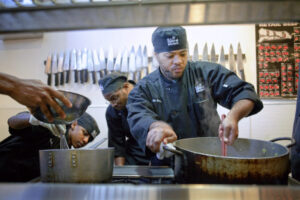
At the Campus Kitchen at Northwestern University (CKNU), not only does Sodexo provide donated food, kitchen space and materials, it is not uncommon for employees to help train CKNU volunteers, prepare and deliver meals, or step in to share food service expertise with CKNU teams regarding products or food safety. Chefs show volunteers how to properly prepare and store food, while a nutritionist teaches them about healthy eating and serving nutritious meals. This allows CKNU to create meals that have “a more nutritious bang for the buck,” according to CKNU coordinator Katie Darin.

Last month, CKNU launched a new nutrition education program for Family Focus – an organization in Illinois that provides education and training programs to help families raise healthy children. Sodexo chefs have been volunteering their time and expertise to help teach Family Focus clients about nutrition. “Chef Marsha Dawkins and Manager Grace Knight recently held a demonstration on how to make a quick, healthy meal out of items you might already have in your pantry,” Darin said. CKNU hopes the new program will keep going strong with the help of Sodexo.

The Campus Kitchen at Marquette University (CKMU) also owes a lot to a Sodexo employee. Sharon Hope works in Straz Tower at Marquette, taking care of her students and making sure their dietary needs are met. Her spare time then goes toward helping CKMU plan and cook meals for their clients in Milwaukee. Sharon has been known to work for CKMU as many as 30 hours a week during the summer preparing as many as 500 meals on a weekly basis. Her efforts were recently recognized when she won a Sodexo Experience award, and she was honored as a Hero of Everyday Life in 2005.

Northwestern and Marquette are just two of many Campus Kitchens that work with Sodexo employees to help feed their communities during Servathon in April – and every other month of the year.


Donate Now Follow us on Facebook