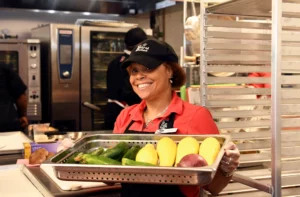
Farmer's Markets Bring Campus Kitchens Closer to the Community

Volunteers at the Campus Kitchen at Augsburg College (CKAC) in Minneapolis didn’t always have the fresh, local produce they wanted to incorporate into meals and provide to local food banks - so they created their own source for high quality vegetables, and with it, a little economic empowerment.
The Campus Kitchen tested the waters of an on-campus farmer’s market program last summer, and has a few years experience at running its Community Supported Agriculture (CSA) program. With the start of the farmer’s market season at the end of June, this summer promises more donations and economic opportunity for the Minneapolis community as programs expand to connect the campus community with something larger.
CKAC Coordinator Brian Noy said the farmer’s market project began as an offshoot of the one he helped start with a community partner, the Brian Coyle Community Center. That site, together with the on-campus market, makes up the West Bank Farmer’s Markets.
“The Brian Coyle Center is right against the project high rises that hold the majority of the center’s population,” said Noy. “The Brian Coyle customers are mostly Somalians from that neighborhood, whereas the on-campus market is mostly faculty and students. But we do distribute leaflets and fliers to let everyone know about both locations.”
Three Hmong farmers display their vegetables – carrots, zucchini, cucumber, lettuces, onions, and herbs currently - at the Brian Coyle location from 11 a.m. to 1 p.m. every Tuesday, and then six blocks away from 2 to 5 p.m., just in front of the campus chapel. Noy said the second opportunity gives these farmers a greater chance of selling more perishable goods in one day.
“It’s providing additional income to farmer’s who would actually qualify for our meal deliveries,” said Noy. “They are all first generation or immigrant farmers. And they are providing affordable access to healthy food.”
As an added benefit, the Campus Kitchen gets all of the excess perishables from both the farmer's market and CSA, which runs on Thursdays, to serve in a simple salad or sautee as a side dish for meals. On a given week, the Campus Kitchen might get up to one hundred pounds of vegetables from each program, and often provides a good portion of those vegetables to local food shelves.
In addition to the cyclical relationship of more healthy food and more economic opportunities, the farmer's markets give something back to The Campus Kitchens Project too.
“In general, campuses are a fantastic place for farmer’s markets,” said Noy. “You have a lot of people centralized, and they do a great thing in expanding and telling the Campus Kitchen story.”